The Discipleship You Didn’t Sign Up For
Every Church leader knows that discipleship is slow, intentional work. It happens in the sermon, in the small group, in the pastoral conversation at the kitchen table. It happens through years of faithful teaching, patient relationship, and the quiet work of the Holy Spirit in the lives of ordinary people.
What fewer people recognize with is that their congregation is also being discipled — every single day — by something they did not choose and cannot fully control.
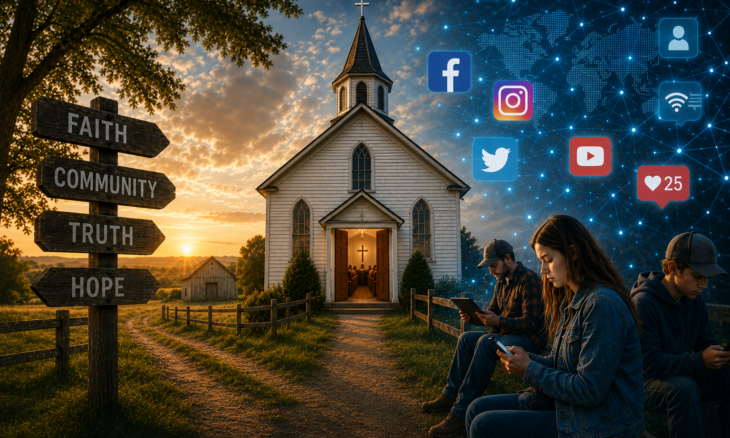
The average American adult now spends between four and six hours per day on their phone. A significant portion of that time is spent on social media platforms — Facebook, Instagram, YouTube, TikTok, X — each of which is powered by algorithms specifically designed to maximize engagement by delivering content that provokes strong emotional responses. Outrage. Fear. Tribal loyalty. The pleasure  of feeling right while others are wrong.
Your congregation members are not passive recipients of this content. They are being actively formed by it — their assumptions about the world, their emotional reflexes, their theological instincts, their political identities, their capacity for attention and patience, their ability to sit with ambiguity — all of it is being shaped, hour by hour, by what their feed delivers.
And here is the pastoral reality: the formation happening on the screen is often working in direct opposition to the formation you are trying to cultivate on Sunday morning. The sermon calls for patience; the feed rewards outrage. The gospel calls for humility; the algorithm rewards pride and arrogance. Jesus prayed for unity around truth; the platform rewards tribal loyalty and the contempt of the outgroup. The Word calls for deep attention; the scroll trains the mind toward distraction and novelty.
This is not a reason for despair. It is a reason for clarity — and for a more intentional, informed, and reasoned approach to discipling your congregation through the digital age.
This article is written to understand what social media is actually doing to the people in your seats, and to give you practical guidance for helping them navigate it faithfully.
What Social Media Is Actually Doing to Your People
Understanding the mechanisms behind social media is not a technical exercise — it is an essential one for those who are shepherding. The better you understand how these platforms work and what they are designed to do, the better equipped you are to shepherd people through them.
The Algorithm Is Not Neutral
Every major social media platform runs on an algorithm — a system that decides what content each user sees, in what order, and how prominently. These algorithms are not designed to deliver the most accurate, balanced, or edifying content. They are designed to maximize engagement — to keep users on the platform as long as possible, because time on platform translates to advertising revenue.
 The most consistent finding in research on social media algorithms is that content provoking strong negative emotions — outrage, fear, moral indignation — generates more engagement than content that is calm, nuanced, or constructive. The algorithm learns this about each user and adjusts accordingly, delivering increasingly provocative content because provocative content keeps people scrolling.
The pastoral implication is significant: your congregation members who spend significant time on social media are being systematically exposed to a diet of content specifically selected to provoke their strongest negative emotions. This has measurable effects on anxiety levels, anger, political polarization, and the capacity for nuanced thinking. It is not neutral. It is formation — in the wrong direction.
Online Theology and the Replacement of the Local Church
One of the most consequential developments in contemporary rural ministry is the rise of online theological content — podcasts, YouTube preachers, Instagram Bible teachers, theological influencers of every tradition — and its effect on the relationship between rural believers and their local churches.
The appeal of online theology to rural believers is genuine and understandable. For the first time in history, a farmer in a remote county has access to some of the most gifted Bible teachers in the world, for free, on demand. This is a remarkable gift. But it carries real risks.
The online teacher does not know your congregation. He preaches to an abstraction — a generalized audience — not to the woman in your third row who lost her husband three months ago, or the  teenager in the back who is wrestling with serious doubt, or the elder who needs to hear this particular text applied to this particular community in this particular season. You do. That specificity is irreplaceable.
Online theology also cannot provide what the local church uniquely provides: embodied community, mutual accountability, the bearing of one another’s burdens in physical presence. The podcast cannot baptize. The YouTube pastor cannot sit with a grieving family. The algorithm cannot break bread with your congregation at the Table.
But the bigger risk is subtler: when a congregation member develops a primary theological identity shaped by an online teacher or tradition rather than by their local church, the result is often a kind of parallel loyalty — an allegiance to the online community that quietly competes with and sometimes supersedes their commitment to the gathered Body. They begin to evaluate their local church through the lens of their online tribe rather than the other way around.
The rural minister who understands this dynamic is far better equipped to address it — not defensively, but pastorally, helping his congregation see the irreplaceable value of the local church in terms the digital age cannot offer.
Screen Time and the Formation of Attention
There is a discipleship dimension to the social media crisis that rarely gets addressed in pastoral contexts: what heavy screen use is doing to the human capacity for attention.
Deep prayer requires sustained attention. Meaningful Bible study requires sustained attention. Genuine listening in pastoral conversation requires sustained attention. The ability to sit with ambiguity, to hold complexity, to resist the pull toward easy answers — all of these require a quality of attention that is increasingly rare and increasingly difficult to cultivate.
Social media platforms are specifically designed to fragment attention — to deliver rapid, varied, emotionally stimulating content in short bursts that train the brain toward novelty-seeking and away from the sustained focus that spiritual formation requires. The congregation member who has spent the week scrolling through their feed does not arrive on Sunday morning with a mind primed for deep engagement with God’s Word. They arrive with a mind that has been trained to expect stimulation, novelty, and brevity — and to disengage when it doesn’t get them.
This is a neurological reality. And it means that part of the preacher’s discipleship work in the digital age is helping people reclaim and protect the quality of attention that the spiritual life requires.
Political Division and the Culture War Online
Perhaps no dimension of social media’s effect on rural congregations is more immediately visible — or more damaging — than its role in political polarization and culture war conflict.
Social media algorithms are extraordinarily efficient at sorting people into political tribes and then feeding each tribe a steady diet of content that confirms their existing beliefs and inflames their suspicion and contempt for the other side. The result, well-documented in research, is that people’s political views become more extreme, more emotionally charged, and more identity-defining the more  time they spend on social media.
For the rural church, which has always occupied a central place in community life and drawn people from across the social spectrum, this creates a specific crisis. Members of the same congregation — people who share the same faith, the same baptism, the same Table — have been sorted by the algorithm into different political realities that barely overlap. They bring that division into the pew. And the minister is left trying to hold together a community whose members have been trained, day by day, to view the other side not as fellow believers with different political opinions but as enemies of everything good and true.
This is one of the most serious and least discussed effects of social media on the rural church. And it requires a pastoral response that is both theologically grounded and practically wise.
What the Bible Says
Colossians 2:8 — Taken Captive
“See to it that no one takes you captive through hollow and deceptive philosophy, which depends on human tradition and the elemental spiritual forces of this world rather than on Christ.”
Paul’s warning to the Colossians resonates with striking force in the age of social media. The specific content of hollow philosophy changes with every generation, but the mechanism is the same: ideas and frameworks that are not tethered to Christ and his Word but depend on human tradition, cultural momentum, and the spirit of the age. The digital world is saturated with exactly this kind of content — sophisticated, appealing, emotionally resonant, and subtly or explicitly at odds with the gospel.
The call embedded in this verse is watchfulness — the alert, discerning attention of a shepherd who knows what his flock is consuming and is ready to name, with gentleness and clarity, when something is leading them away from Christ.
Philippians 4:8 — The Standard of the Mind
“Finally, brothers, whatever is true, whatever is honorable, whatever is just, whatever is pure, whatever is lovely, whatever is commendable, if there is any excellence, if there is anything worthy of praise, think about these things.”
This verse is often quoted in isolation as a general encouragement toward positive thinking. But in the context of digital discipleship, it functions as a specific and practical standard for evaluating what we allow into our minds through our screens.
True. Honorable. Just. Pure. Lovely. Commendable. Excellent. Worthy of praise.
How much of what the average social media feed delivers meets this standard? How much of it is outrage-bait, tribal conflict, anxious speculation, or content designed to provoke rather than edify? The Philippians 4:8 standard is not a call to naivety or disengagement from the world — it is a call to intentional curation of the mind’s diet. And it is a standard that every congregation member can apply concretely to their digital consumption.
Acts 17:11 — The Berean Model
When Paul preached in Berea, “they received the word with all eagerness, examining the Scriptures daily to  see if these things were so.” (Acts 17:11)
The Bereans are the biblical model for engaging the age of online theology. They were not passive, uncritical consumers of teaching. They were active, discerning, Scripture-testing listeners — eager to receive, but unwilling to accept anything that had not been tested against God’s Word.
This is the posture you want to cultivate in your congregation toward all theological content, online and offline. Not reflexive suspicion of everything digital. Not uncritical acceptance of whatever a popular teacher says. Eager, engaged, Scripture-testing discernment — the kind of theological maturity that can hold its own in the digital marketplace of ideas.
Romans 12:2 — The Countercultural Mind
“Do not be conformed to this world, but be transformed by the renewal of your mind, that by testing you may discern what is the will of God, what is good and acceptable and perfect.”
The word Paul uses for “conformed” — suschematizo — carries the sense of being pressed into a mold from the outside. The world presses. The algorithm presses. The feed presses. And without intentional resistance and active renewal, the mind takes the shape of the mold it sits in.
The antidote is not withdrawal from the world — it is active, ongoing renewal of the mind through immersion in God’s Word and the life of the Spirit. The congregation that is deeply formed by Scripture, prayer, and genuine Christian community has a resilience against the conforming pressure of digital culture that cannot be achieved any other way.
Practical Discipleship Guidance
Name It From the Pulpit
The most important first step is also the simplest: talk about it. Research shows most rural ministers have never explicitly addressed social media, screen time, or online theology from the pulpit. Their congregations are navigating the digital landscape entirely without pastoral guidance, making it up as they go.
Name the landscape. Explain, simply and clearly, how social media algorithms work and what they are designed to do. Help your congregation understand that their feed is not a neutral window on the world — it is a carefully engineered environment designed to provoke emotional engagement. Teach the Philippians 4:8 standard as a practical tool for evaluating digital content. Preach the Berean model of Scripture-testing as a life skill for the digital age.
You do not need to be a technology expert to do this. You need to be a faithful shepherd who takes seriously the forces shaping your congregation’s inner life.
Equip for Theological Discernment
Online theological content is not going away, and it is not uniformly harmful. Your goal is not to eliminate your congregation’s access to outside teaching — it is to help them engage it with the discernment of mature believers.
Teach your congregation how to evaluate theological content. What tradition does this teacher represent, and what are its strengths and blind spots? Is the teaching tethered to the text of Scripture or does it use Scripture as decoration for pre-formed conclusions? Does it build up the local church or subtly undermine it? Does it produce love, humility, and unity, or does it produce pride, division, and contempt for those who disagree?
These are questions your congregation can learn to ask. And a congregation that asks them is a congregation that can benefit from the genuine resources of the digital theological world without being destabilized by its dangers.
Consider getting ahead of your congregation’s online consumption by proactively recommending resources you have evaluated and trust. Give them a curated starting point. Communicate that you are engaged with the digital landscape and can serve as a guide within it — not a gatekeeper, but a trusted navigator.
Address Political Division Directly and Pastorally
The culture war dynamics that social media imports into rural congregations will not resolve themselves. They require direct, courageous, gracious pastoral engagement.
This does not mean preaching partisan politics from the pulpit — it means preaching the gospel’s implications for how believers relate to one another across differences. It means teaching Romans 14-15 and the strong-and-weak framework with explicit application to political disagreement. It means preaching Ephesians 2 — that the dividing wall of hostility has been demolished in Christ — with explicit acknowledgment that the algorithm is trying to rebuild it.
It means modeling, in your own presence and communication, what it looks like to hold firm convictions about ultimate things while maintaining genuine love toward those with whom you differ on secondary things. And it means having individual conversations with congregation members who are being radicalized — gently, directly, and with the patient love of a shepherd who is watching over their souls.
Help Your People Reclaim Their Attention
This is a discipleship issue that most of us have never framed as a discipleship issue — but it is one.
Help your congregation understand what heavy screen use is doing to their capacity for attention, and why that capacity matters for the spiritual life. Encourage concrete, practical practices: a no-phone  Sunday morning policy before worship. A daily period of phone-free time for prayer and Scripture reading. A regular digital sabbath — one day per week of deliberate disengagement from screens and social media.
These are not legalistic rules. They are spiritual disciplines appropriate to the particular temptations and pressures of the digital age — the same way fasting is a discipline appropriate to the temptation of placing too much value on physical comfort. Help your congregation see them that way.
Create Space for the Hard Questions
One of the reasons online content is so appealing — including deconstruction content and the kind that generates doubt and theological instability — is that it addresses questions people are genuinely asking. Questions about doubt, about suffering, about the credibility of the Bible, about how faith relates to science and culture and politics.
If those questions have no home in the local church, people will find answers for them somewhere else. And the somewhere else is increasingly a digital space that may not serve them well.
Create space. A Sunday school class that engages hard questions without flinching. A small group that studies theologically substantive content and discusses it honestly. A leader who is approachable enough that a congregation member can say “I heard something online that troubled me” and receive a genuine, engaged response.
The local church that creates this kind of space keeps the discipleship conversation inside the Body — where it belongs, where it can be held in the context of relationship and accountability and the full counsel of God’s Word.
Conclusion: The Feed Cannot Form You
The social media feed, for all its reach and power, cannot do what the local church does.
It cannot know you. It cannot bear your burdens. It cannot hold you accountable. It cannot baptize you or break bread with you. It cannot watch over your soul. It cannot form you, over years of faithful presence, into the image of Christ.
It can inform you. It can entertain you. It can connect you to a global conversation. And it can, if you are not careful, slowly press you into a shape that looks less and less like the person the gospel is calling you to become.
Your job as a leader is to help your congregation see that difference — clearly, compassionately, and repeatedly. To help them engage the digital world with the discernment of the Bereans, the standard of Philippians 4:8, and the grounded identity of people who know they are being formed, above all, by something older, deeper, and truer than anything their feed can deliver.
The Word of God. The Body of Christ. The life of the Spirit.
These are the things that form. Everything else is noise.
“Do not be conformed to this world, but be transformed by the renewal of your mind.” — Romans 12:2


